
 English
 français
 Deutsch
 русский
 español
 العربية
 日本語
 한국의
 ไทย
 हिन्दी

question?
If you have questions or suggestions,please leave us a message,we will reply you as soon as we can!
Contact us
If you have questions or suggestions,please leave us a message,we will reply you as soon as we can!
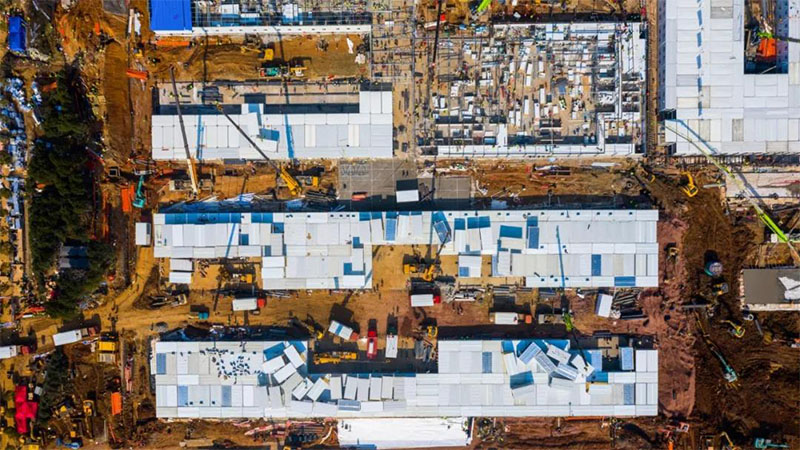
Contact usOn February 2, construction of Wuhan Vulcan Mountain Hospital was officially completed.
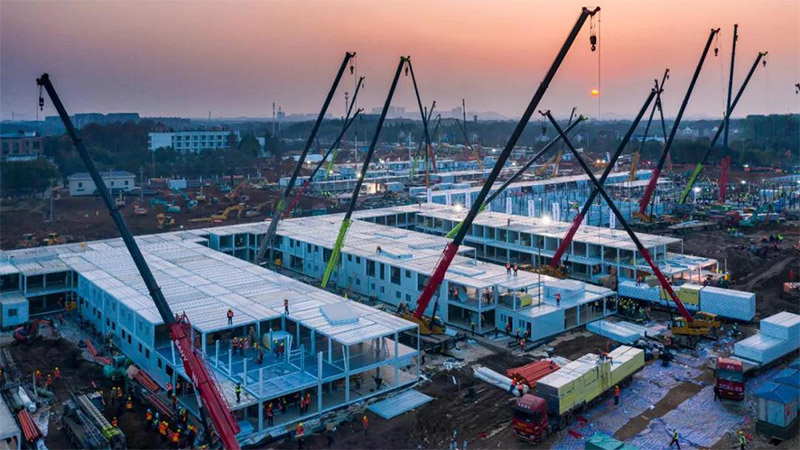
Every second counts in this intense race against time.
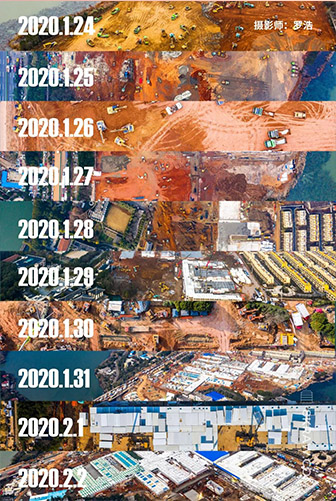
On January 24, Chinese New Year's Eve, hundreds of excavators arrived on-site to begin ground leveling.
On January 25, the first day of the Lunar New Year, construction of Vulcan Mountain Hospital officially commenced.
On January 26, the second day of the Chinese New Year, construction of the anti-seepage layer began in full force, underground pipeline trenches were excavated, and modular container board materials arrived on-site continuously.
On January 27, the third day of the Lunar New Year, site leveling and backfilling with gravel and yellow sand were completed, and the first batch of modular container units was hoisted.
On January 28, the fourth day of the Lunar New Year, the steel framework of a two-story ward building began taking shape.
On January 29, framework assembly for more than 300 modular box-type structures was completed during the Lunar New Year holiday.
On January 30, the sixth day of the Lunar New Year, installation of the HDPE membrane was fully completed, and sewage treatment room equipment was hoisted simultaneously.
On January 31, the seventh day of the Lunar New Year, 90% of container assembly was completed, with prefabricated modular structures erected across 3,000 square meters.
On February 1, the eighth day of the Lunar New Year, the installation of medical cleanroom equipment commenced at full scale.
On February 2, the ninth day of the Lunar New Year, construction of the Vulcan Mountain Hospital project was successfully completed.
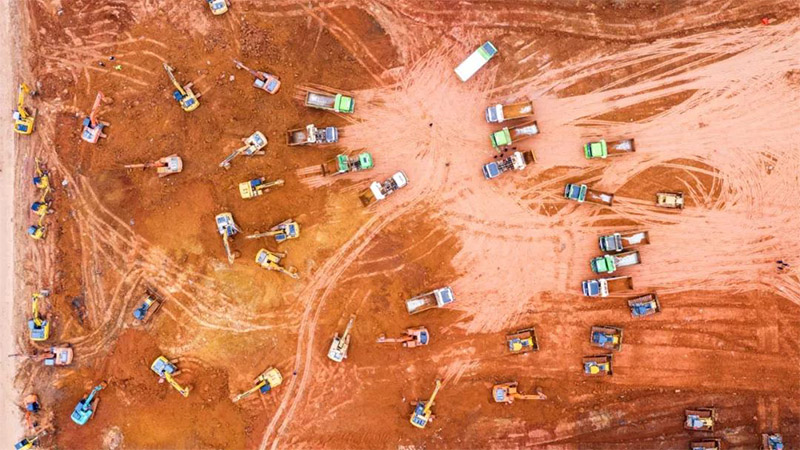
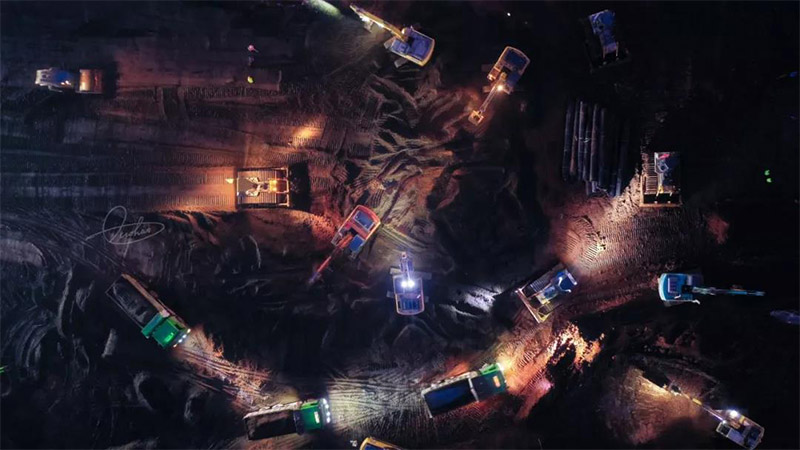
During peak construction, more than 4,000 builders worked on-site alongside nearly a thousand large-scale machines and vehicles under 24 hours of uninterrupted construction, once again demonstrating China's speed and efficiency. The equally prominent Thunder Mountain Hospital is also scheduled for completion on February 5. In this urgent race against the epidemic, how was an emergency hospital built in about 10 days? Can the two hospitals meet the demand? Will construction cause pollution to nearby lakes?
Focus 1: Can The Two Hospitals Meet The Demand?
"The newly built Vulcan Mountain Hospital and Lei Shenshan Hospital can accommodate about 2,300 beds," Wuhan Mayor Zhou Xianwang announced at a press conference on January 26. The city will also renovate 6 hospitals in outlying districts, adding about 10,000 beds to promptly treat confirmed cases. In response to the evolving epidemic situation, Wuhan decided on January 29 to expand the capacity of Lei Shen Shan Hospital from the original design of 1,300 beds to about 1,600 beds.
Focus 2: HowTo Build A Hospital In 10 Days?
At 11 pm on January 31, when many people had gone to sleep, Li Jian, project leader at Cnsterilezoom, wearing a mask, remained at the busy construction site of Vulcan Mountain Hospital, directing workers operating in full swing. According to the schedule, Vulcan Mountain Hospital will be completed on February 2nd, meaning a construction period of only 10 days from initial site work on January 23rd to final completion. In contrast, construction of Thunder Mountain Hospital progressed even faster. In just 5 days since official construction began on January 26, more than 60% of the overall construction progress had been completed.
\"Behind this rapid speed is continuous innovation in construction technology.\" Wu Hongtao, secretary of the party committee of Cnsterilezoom who is directing work on-site at Lei Shenshan Hospital, noted that building both hospitals relies on the industry's most advanced modular assembly construction techniques. Maximizing the use of prefabricated industrial components substantially decreases on-site workload and saves significant time. Concurrently, after external assembly, complete modular hoisting is carried out, coordinating on-site construction and integrated lifting to deliver optimal efficiency.
Focus 3: How To Mobilize A Large Number Of Construction Workers In The Short Term?
The project deployed more than 2,000 workers alongside nearly 1,000 units of various large-scale machinery and transport vehicles working around the clock 24 hours a day. During the Spring Festival holiday, numerous migrant workers had already returned home for Chinese New Year. How was it possible to assemble such a workforce in such a short window? Ye Jian, Manager of the Technical Department of Cnsterilezoom responsible for the Vulcan Mountain build, explained that on the night of January 23, Cnsterilezoom rapidly organized over 1,400 overtime workers from five active construction projects in Wuhan, enabling essential tasks like site ground leveling to commence immediately.
Simultaneously, Cnsterilezoom distributed \"hero notices\" to rapidly assemble personnel through partner subcontracting firms. Fu Jianping, general manager of Hubei Hanyu Labor Service Co., Ltd., stated that following notification on the evening of January 23, he traveled by bus directly to Enshi early on the morning of the 24th, continuing onward to gather workers across Yichang, Jingmen, Jingzhou, Xiantao, and beyond; at the same time, rural workers surrounding Wuhan were mobilized to join the effort.
At the start of the Spring Festival, certain workers were initially hesitant to return. Yet upon hearing that the mission was to construct a hospital facility for pneumonia patients infected with the novel coronavirus, many promptly volunteered. \"Everyone wanted to complete hospital construction as quickly as possible to help overcome the epidemic,\" Fu Jianping recounted, noting that by the evening of the 24th, they had brought over 300 workers onto the construction site.
Focus 4: How To Prevent Cross Infection In The Hospital?
Inside the demonstration isolation ward at Lei Shen Shan Hospital, there is a pass box featuring double-layer glass and an integrated ultraviolet sterilization system. Patient meals and prescription medications are passed through this pass box and sanitized by the ultraviolet system to effectively prevent cross-infection. Each isolation room provides two beds alongside a separate private bathroom.
"It is necessary to strictly prevent pollution of the surrounding environment and strictly control cross-infection in the hospital," said Yang Jianhua, chief designer of the Lei Shenshan Hospital project and deputy secretary of the Cnsterilezoom Party Committee. As a principle, a strict "three zones and two passages" design is adopted, and the medical staff arranges the work area according to the work process of "clean area-semi-polluted area-polluted area". Every time you enter the first-level area, the medical channel is completely separated from the patient channel, providing a safe and reliable working environment for medical workers.
Focus 5: Will It Cause Pollution To Nearby Lakes?
"It will not pollute nearby lakes," said Li Yongfeng, technical director of the installation company of Cnsterilezoom. The hospital's wastewater must go through seven strict procedures from discharge to qualified treatment. Firstly, it must be completely enclosed and pre-sterilized in the hospital, and then transferred to the sewage treatment station for biochemical treatment. After passing the system test, it will be discharged into the municipal pipe network. According to Li Yongfeng's calculation, each hospital can produce a maximum of 800 to 1,000 tons of sewage per day, and the sewage treatment capacity of each hospital can reach a maximum of 80 tons per hour. "That is, each hospital can handle up to 2000 tons of sewage per day. The processing capacity is very sufficient."
Rainwater protection is equally thorough. Zhang Songmin, waterproof designer of Cnsterilezoom, introduced that in order to prevent rainwater from seeping into the ground, the ground across the isolation zone was fully hardened. Three layers of protection, including a concrete base, anti-seepage membrane, and reinforced concrete ground, ensure rain-free water seepage. Rainwater is collected into the storage tank in the hospital, and then discharged into the urban sewage system after disinfection.
Focus 6: Will It Affect The Health Of Residents Around The Hospital?
"The locations of these two hospitals are located in the downwind direction of Wuhan," Yang Jianhua said, noting that the Houguan Lake and Huangjia Lake areas where the two hospitals are located are downwind. High-altitude emissions are not released until national standards are met. Yang Jianhua said that most of the hospital's medical technology rooms are negative pressure rooms, and the fresh air volume is increased in the ward and ICU according to relevant specifications. In this case, the pressure in the room is lower than outside, which effectively prevents the virus from passing outside with airflow and polluting outdoor air.
Focus 7: How To Use After Delivery? Is It Temporary Construction Or Long-term Use?
Following the completion of Vulcan Mountain Hospital, the facility will be handed over to designated units of the People's Liberation Army for management as a specialized hospital for the centralized treatment of patients infected with the novel coronavirus pneumonia.
Vulcan Mountain Hospital uses container houses, while Raytheon Mountain Hospital is a temporary steel frame building. Regarding whether the two hospitals will continue to be used after the epidemic, the relevant person in charge of the Wuhan Urban and Rural Construction Bureau said that this will be determined after the epidemic concludes.
According to Wu Hongtao, functionally speaking, the two hospitals can meet the needs of long-term use after completion. At the same time, thanks to the standardized and modular design, all buildings can be quickly dismantled and the components can be reused after being disinfected.
 online service
 info@cnsterilezoom.com